



You have been dreaming about a brighter, more even smile, and your research keeps surfacing the word “veneers.” Then a new wrinkle appears, because suddenly there are two kinds, traditional and no-prep, and the internet cannot seem to agree on which one is better. If you are picturing a confusing fork in the road, take a breath, because this choice is more straightforward than it looks.
At Green Lake Cosmetic Dentistry, we walk Green Lake and North Seattle patients through this decision every week, and we believe a little clarity goes a long way. Both options can transform a smile, yet they differ in how much of your natural tooth is involved, how long they tend to last, and who makes a good candidate. Understanding those differences is the first step toward choosing the right path, and our team is happy to compare them with the same care we bring to every set of porcelain veneers we craft.
What Traditional Veneers Actually Involve
Traditional veneers are thin, custom shells, usually porcelain, bonded to the front surface of your teeth to reshape color, size, and contour. To make room for the shell and create a seamless fit, we remove a small amount of enamel, typically around half a millimeter to a full millimeter. That reduction is what allows the veneer to sit flush with neighboring teeth rather than looking bulky or stepped out.
Because enamel does not grow back, traditional veneers are considered a permanent commitment. The American Dental Association’s consumer health resource on veneers explains that the procedure is not reversible once enamel is removed, which is exactly why a thoughtful consultation matters so much. The upside is durability and versatility, since traditional veneers handle more dramatic changes, like deeper stains, larger gaps, and noticeable chips, with strong, natural-looking results.
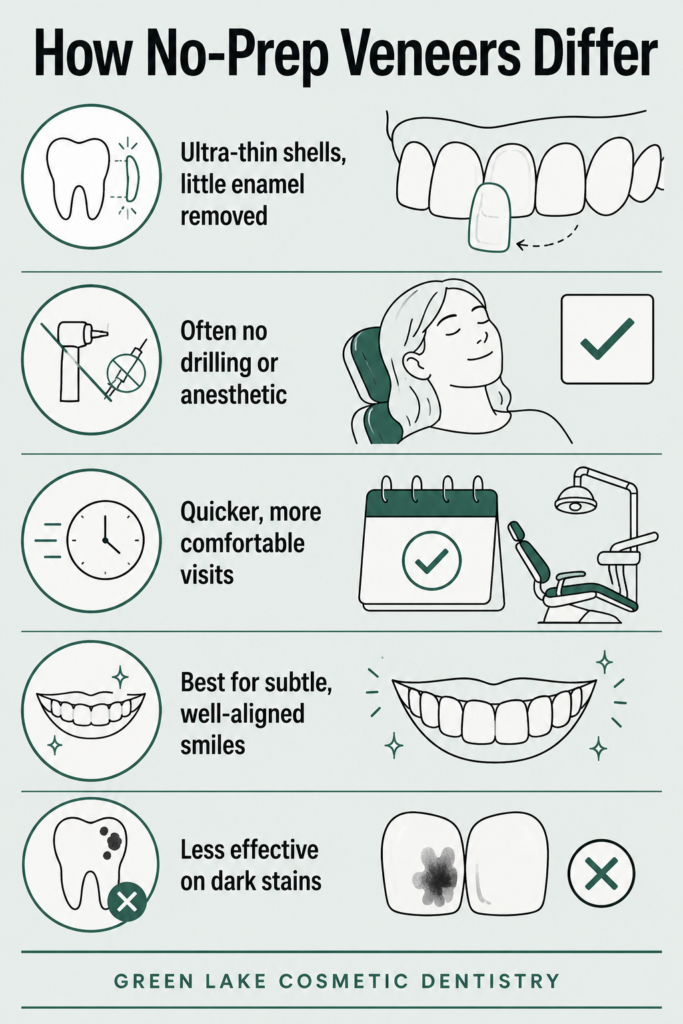
How No-Prep Veneers Are Different
No-prep veneers, sometimes recognized by brand names such as Lumineers, are ultra-thin shells designed to bond to your teeth with little to no enamel removal. For the right candidate, that means no drilling, often no anesthetic, and in some cases a reversible result. The appeal is obvious, because the process is usually quicker and more comfortable, and your natural tooth structure stays largely untouched.
The trade-off is candidacy. No-prep veneers work beautifully when teeth are already well-aligned and only need a refresh in shape or shade, yet they can look thick on teeth that are larger or more prominent. They also tend to be less effective at masking very dark discoloration. If your goals lean toward subtle enhancement, no-prep may be a wonderful fit, while more significant corrections often call for the traditional approach.
Choosing the Right Option for Your Smile
So how do you decide? The honest answer is that it depends on your teeth, your goals, and your timeline, which is why a personalized exam beats any online checklist. We look at your enamel, your bite, the shade you are hoping to reach, and whether other treatments might get you there with less. Sometimes composite bonding addresses a single chip or gap without any veneers at all, and sometimes professional teeth whitening brightens your smile enough that veneers become optional.
Dr. Cherryl Ellison focuses on family and cosmetic dentistry, stays current through memberships in the Spear and Seattle Study Clubs, and is genuinely passionate about making your visit comfortable and enjoyable, so a conversation about your options should feel exciting rather than overwhelming. If you live in Green Lake, Wallingford, Phinney Ridge, or anywhere across North Seattle, we invite you to schedule your consultation so we can map out the smile you have been picturing together.